
RAID: Shadow Legends explained: how it plays, what it costs and who it suits
Advertising disclosure. This article contains partner links to RAID: Shadow Legends, marked “Partner link”. If you install or buy through them we may earn a commission, at no extra cost to you. The commission does not change what we write: see our editorial policy. tevana.online is not affiliated with, endorsed by or sponsored by Plarium.
RAID: Shadow Legends is a free-to-download fantasy role-playing game in which you collect champions, build teams and fight turn-based battles. This guide explains how the game actually works, where the difficulty and the spending pressure come from, and how to decide whether it is worth your time.
What RAID: Shadow Legends is
RAID: Shadow Legends is developed and published by Plarium, a studio owned by the Australian gaming company Aristocrat Leisure. It is a collection RPG, sometimes called a “gacha” game: you build a roster of characters, called champions, partly by playing and partly through randomised summons.
The game is free to download on iOS and Android, and on Windows and macOS through Plarium’s own launcher, Plarium Play. If you link your game to a Plarium account, you can continue the same progress across devices. Check the official site for the platforms currently supported in your region, because availability can change.
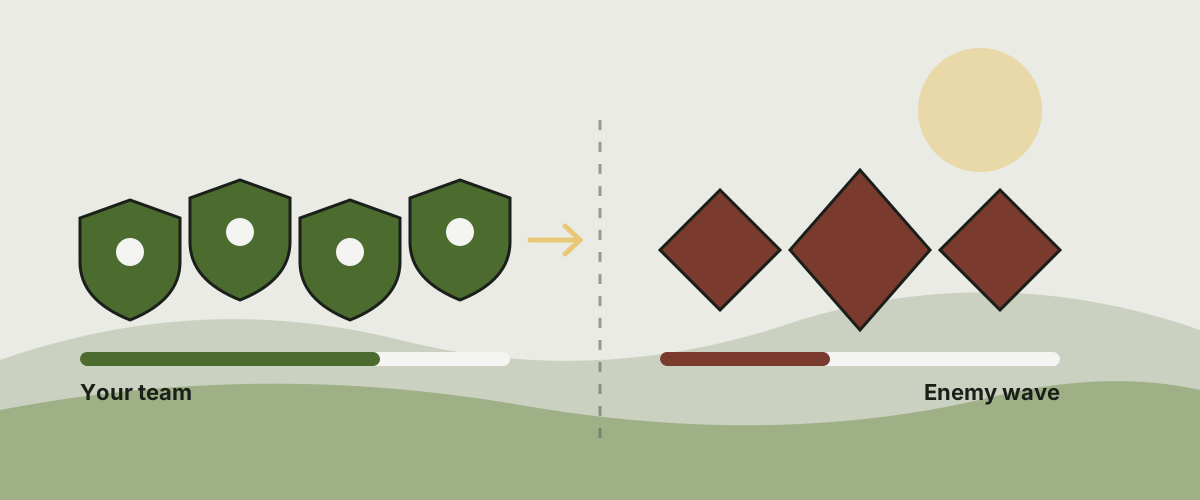
Battles are fought between your team and one or more waves of enemies. Depending on the mode, a team has four or five champions. A turn-based system decides the order in which everyone acts. You can control each move yourself or let the game fight automatically.
How combat works: speed and the turn meter
RAID does not use strict “your turn, my turn” rounds. Each champion and each enemy has a turn meter that fills continuously during the fight. How fast it fills depends on the Speed stat. When a meter is full, that unit acts. So a champion with twice the speed of an enemy will, all else equal, act about twice as often.
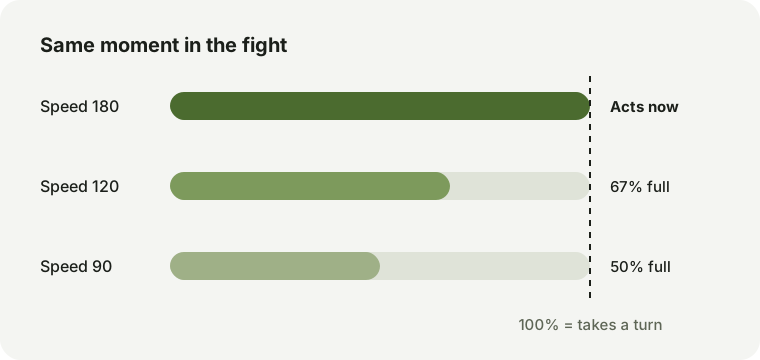
That makes Speed the most important stat for most teams, and it is the reason experienced players spend so much time on gear. Skills can also raise an ally’s turn meter or lower an enemy’s, which adds a second layer of planning.
Each champion usually has a basic attack, one or more active skills with cooldowns (a number of turns before they can be used again) and sometimes a passive ability. Many skills apply buffs (positive effects, such as increased defence) or debuffs (negative effects, such as poison or stun). Whether a debuff lands depends on your Accuracy compared with the target’s Resistance.
Correction to earlier versions of this page: an earlier version said that every battle needs active decisions. In fact RAID includes auto-battle and, in many modes, repeated automatic battles. Most day-to-day farming runs on auto. The strategy lies mainly in how you build and gear your team, and in manual play for the hardest content.
Affinities
Every champion and enemy belongs to one of four affinities: Magic, Force, Spirit or Void. The first three form a triangle of advantage. Void is neutral.
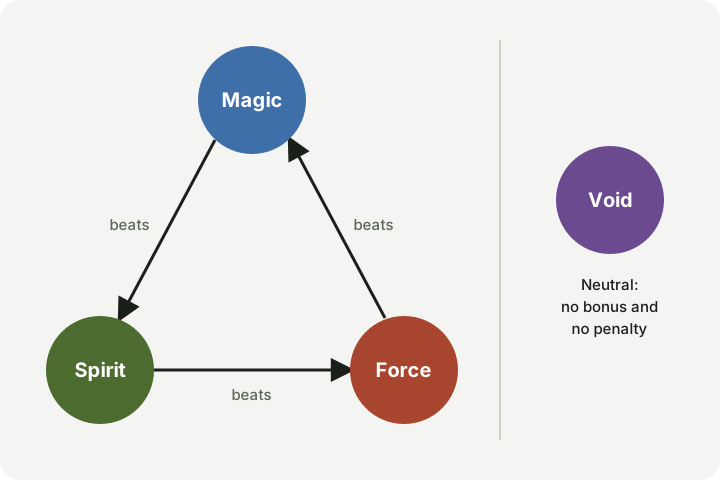
- Magic has the advantage over Spirit.
- Spirit has the advantage over Force.
- Force has the advantage over Magic.
- Void has no advantage and no disadvantage.
Attacking with the advantage can produce stronger hits. Attacking at a disadvantage can produce weaker hits and makes debuffs more likely to fail. That is why some dungeon floors and bosses are much easier with a team of the right affinity. The exact numbers are set by the developer and can change, so treat the in-game help text as the reference.
Correction: an earlier version of this page listed the elements as fire, water, wind, light and dark. Those are not RAID’s affinities. The game uses the four listed above.
Want to see the game for yourself?
Visit RAID: Shadow LegendsPartner linkPartner link: we earn a commission if you install or buy through it. It costs you nothing extra.
Champions, rarities and roles
The roster runs to several hundred champions, and Plarium adds more regularly. An older claim on this page of “over 200 heroes” was out of date and has been removed. Each champion has:
- A rarity: Common, Uncommon, Rare, Epic, Legendary and, for a smaller group, Mythical. Higher rarities usually have more skills and higher base stats.
- A role: Attack, Defense, HP or Support. The role indicates which stats a champion scales with, not a strict job. Many “Defense” champions deal their damage based on their defence stat.
- A faction: more than a dozen factions, grouped into four alliances. Factions matter for Faction Wars (see below) and for some artifact bonuses.
- An affinity, as described above.
Community tier lists are useful, but they mostly rank champions for the hardest endgame content. For the campaign and early dungeons, a well-geared team of Rare and Epic champions with good Speed is enough. No single champion is needed to finish the story campaign. Some top-end content, however, is much easier with specific rare champions, and that is where spending pressure appears.
How champions get stronger
Progression in RAID has several layers. Each one uses a different resource, which is why the game can feel slow to start with.
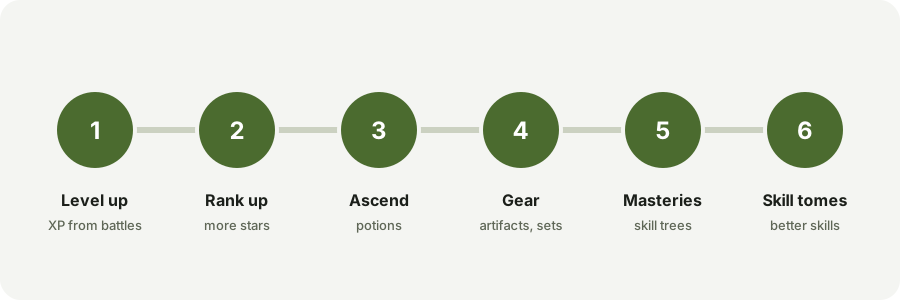
- Levelling. Champions gain experience from battles. The level cap depends on their rank.
- Ranking up. A champion’s rank goes from one to six stars. To rank up, you use other champions of the same rank as material (players call this “food”). This is why the game hands out so many low-rarity champions.
- Ascension. Ascending raises stats further and uses potions farmed in the Potion Keeps.
- Artifacts and accessories. Each champion has six artifact slots (weapon, helmet, shield, gauntlets, chestplate, boots) and, once unlocked, accessory slots (ring, amulet, banner). Wearing several pieces from the same set gives an extra bonus. Gear usually decides more than champion choice does.
- Masteries. At higher ranks, champions can unlock mastery trees that add passive bonuses.
- Skill tomes. Rare items that upgrade a champion’s skills, for example by adding damage or shortening cooldowns.
Game modes
The table lists the main modes at the time of writing. The game adds and reworks content over time, and many modes unlock only after you reach a certain player level.
| Mode | What it is | What it mainly rewards |
|---|---|---|
| Campaign | The story chapters, on several difficulty levels | Experience, silver, early artifacts |
| Dungeons | Repeatable boss stages such as Dragon’s Lair, Ice Golem’s Peak, Spider’s Den and Fire Knight’s Castle | Specific artifact sets and accessories |
| Potion Keeps | Affinity-themed stages | Ascension potions |
| Clan Boss | A daily boss fought with a limited number of keys and shared by your clan | Chests with gear and shards |
| Arena | Fights against other players’ defence teams (Classic, Tag Team and Live Arena variants) | Rankings, arena currency, rewards |
| Faction Wars | Stages that allow only champions from one faction | Rare materials and specific rewards |
| Doom Tower | A multi-floor tower with bosses and rotating rules | Special artifact sets and tomes |
| Clan modes | Cooperative and competitive clan content such as Hydra and Siege | Clan rewards |
Correction: an earlier version described “Clan Wars”. RAID’s clan content goes by names such as Clan Boss, Hydra, Siege and clan-versus-clan tournaments. There were also no “side quests” in the sense that earlier copy suggested. The game has daily, weekly and advanced quests instead.
The daily loop and energy
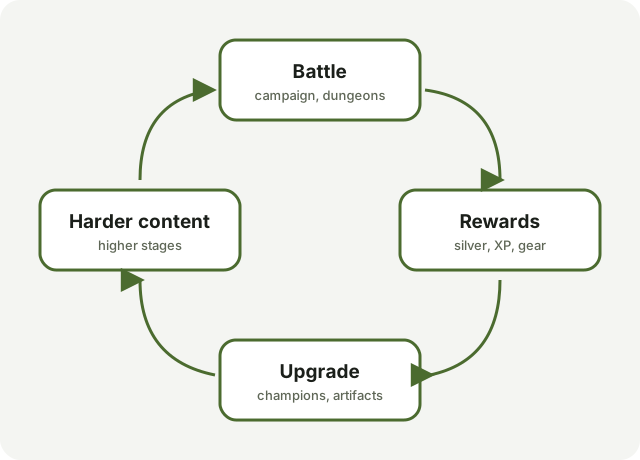
Most modes use up energy, which refills over time. Energy limits how much you can play in one sitting unless you refill it, and refills are sold for the premium currency, gems. The ordinary currency, silver, pays for upgrades and becomes a bottleneck later on.
Daily log-in rewards, daily quests, Clan Boss keys and time-limited events all encourage you to log in every day. Whether that suits you is a personal matter. Some players enjoy the routine; others find it tiring. Events and tournaments often reward reaching point thresholds. Players with more resources reach them more easily, so events are not equally achievable for everyone.
Curious how the loop feels in practice?
Visit RAID: Shadow LegendsPartner linkPartner link: we earn a commission if you install or buy through it. It costs you nothing extra.
Summoning, odds and money
New champions come mainly from shards, which you open (“summon”) for a random champion. The shards you will see most often are Mystery, Ancient, Void and Sacred. Each has its own odds. The game displays the rates in its summon screen, and during events they can temporarily change.
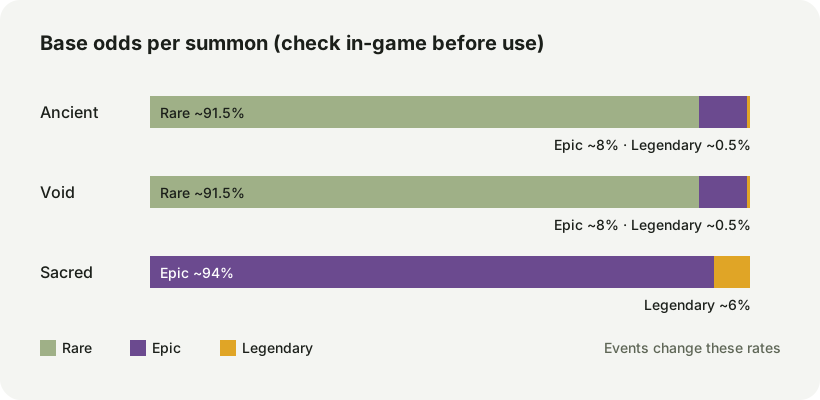
At a base Legendary rate of about 0.5%, you would on average open around 200 Ancient shards per Legendary champion. Random chance means some players get one far sooner and others far later. Plarium has also communicated a “mercy” rule that raises the odds after a long run without a Legendary. The current rules are in the game and on Plarium’s support pages, so check them rather than relying on community summaries.
Is it pay-to-win?
RAID is free to download, and you can play the campaign, dungeons and most modes without paying. The game also sells a wide range of optional purchases: gem packs, shard bundles, energy refills, time-limited offers and recurring packs that deliver rewards over several days.
A fair summary: free players can progress, but slowly. The top positions in competitive modes such as Arena, and the fastest progress through the hardest content, are strongly associated with spending. An earlier version of this page said that events create no pay-to-win pressure, that the game has no recurring purchases and that its odds are unusually transparent compared with other gacha games. We have removed those claims because we could not support them. Publishing odds is now common across the genre, and in some markets it is required.
Summons are random. Paying for a chance of getting a champion is a form of loot box. If you choose to spend, set a limit in advance. Our spending-wisely guide explains how to lock purchases on your phone and read the odds.
Strengths and weaknesses
Strengths
Deep team-building and gear system; many modes with different demands; auto-battle for routine play; progress carries over between phone and computer via a Plarium account; a large player community producing guides.
Weaknesses
Slow progress without spending; many offers and pop-ups; heavy reliance on random summons; gear farming can become repetitive; daily log-in pressure; top competitive content favours spenders.
Likely to suit you if you enjoy planning builds, optimising stats and a long-term collection game you play a little every day.
Less likely to suit you if you want fast, skill-based action, dislike random rewards, or would find the constant purchase offers stressful.
Getting started: the first two weeks
Choose a starter and follow the campaign
At the start you choose one of four champions (Athel, Kael, Galek or Elhain). Community guides often recommend Kael because his area-damage skills help early farming, but any of the four can carry you through the opening chapters. Play through the campaign to unlock more modes.
Do the daily and advanced quests
Quests are a steady source of resources and give you clear goals. The advanced quests also work as an informal tutorial for the game’s systems.
Join an active clan
Clan membership unlocks the Clan Boss and other clan rewards. An active clan also gives you somewhere to ask questions.
Focus on one team
Spread resources too thinly and nothing gets strong. Pick four or five champions that cover damage, healing or defence and crowd control, and gear them first, with Speed as the priority.
Don’t waste good champions as food
Some Rare and Epic champions become important later. Before you use one as rank-up material, look it up in a community guide.
Decide your budget before the first offer appears
New accounts see many “starter” offers. Deciding in advance whether you will spend anything, and how much, makes them easier to ignore.
Ready to try it? It is free to download.
Get RAID: Shadow LegendsPartner linkPartner link: we earn a commission if you install or buy through it. It costs you nothing extra.
Frequently asked questions
Is RAID: Shadow Legends free?
Yes, it is free to download and play, with optional in-game purchases.
Can I play on PC?
Yes. Plarium offers Windows and macOS versions through Plarium Play, alongside the mobile versions. Check the official site for current system requirements.
What is the age rating?
Ratings vary by country and store. Check the listing in your app store before installing, especially for a child, and turn on purchase restrictions.
Can I lose my progress?
Link your game to a Plarium account so that your progress is saved to it and can be restored on another device.
Sources and method
This guide was written from the game’s publicly available information and in-game help texts, and checked against the following public sources on 25 September 2026:
- Plarium, official RAID: Shadow Legends website: raidshadowlegends.com
- Plarium, company website and support pages: plarium.com
- RAID: Shadow Legends listings on the Apple App Store and Google Play, for platform and in-app purchase information
- Aristocrat Leisure Limited, corporate information on its ownership of Plarium: aristocrat.com
Figures such as summon rates change. If anything here differs from information published by Plarium, Plarium’s information prevails. If you spot an error, email info@tevana.online. Our corrections procedure explains what happens next.
All illustrations, charts and diagrams on this page are original works created for tevana.online. They are not screenshots of the game and use no game artwork.
Trademark notice
RAID: Shadow Legends and Plarium are trademarks of their respective owners. tevana.online is an independent publication operated by CDB INTERNATIONAL s.r.o.. It is not affiliated with, endorsed by or sponsored by Plarium Global Ltd or Aristocrat Leisure. We may earn an affiliate commission through the partner links above.